On this page
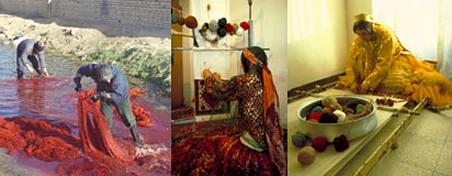
Geography and people describes the lifestyle of rug weavers whose way of life has a direct influence on their weaving. The lifestyle of many weaving tribes such as Turkomans, Baluchis, Lurs, Bakhtiaris, Kurds, Qashqais, Afshars, North Africans, Tibetans and Native Americans in addition to some tribes of Anatolia and the Caucasus can clearly be seen in their woven work; on the other hand, Indian, Chinese, Pakistani and some Iranian rug weavers are mainly city weavers whose lifestyle does not affect their weaving. Their weaving is affected by the demands of the Western market.
Therefore, this section will mainly be concerned with the life of tribal weavers. Some of the tribes mentioned above reside in more than one country as can be seen in the examples in this section.
Turkomans
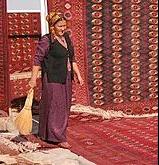
Turkoman handmade area rugs are distinctive because they are always made with 100 percent pure wool, and the weavers utilize geometric shapes. Additionally, the majority of Turkoman rugs feature a red or reddish-brown background. The rugs that are produced by Turkoman tribes are often referred to as Turkmen rugs, and they were historically known as Bukhara or Afghan rugs.
Turkoman weavers are nomadic, and they live in Afghanistan, Turkmenistan, northeastern Iran and Uzbekistan. There are many Turkoman tribes in these countries, including the Ersari, Salor, Chodor, Saryk, Arabchi, Youmut and Tekke.
These handmade area rugs feature a unique octagonal motif that is called a gul. Each tribe has a gul that they were very protective of several centuries ago, but now all Turkoman weavers are allowed to freely use any gul in their rugs. The Turkomans also use the hatchli design when they make Ensi rugs.
Baluchis
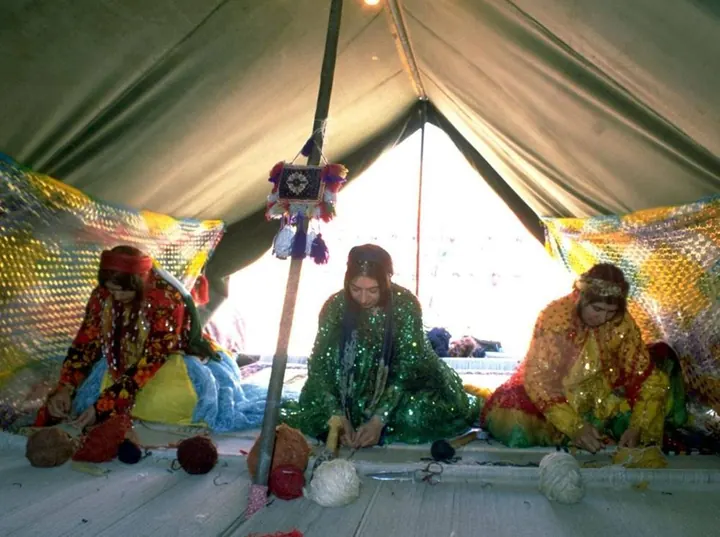
The Baluchi tribes reside in Iran, Afghanistan, and Pakistan. They speak a form of Persian language. It has been said that they may have originally come from the Arabian Peninsula or the surrounding area of present-day Iraq. It has been documented that some Baluchi tribes were found in southern Iran near Kerman in the 10th century, and that in the 13th century, many were migrating across Afghanistan and the southeast Iranian Province of Sistan. In the early 18th century, many were forced by Nadir Shah (a Turkoman ruler who lived from 1688-1747) to migrate north to the Iranian Province of Khorassan near the city of Mashad in the regions of Torbat-e-Jam and Torbat-e-Heydarieh. Torbat-e-Jam has now become the market place for Baluchi weaving.
Today, about half of the Baluchi population live in the Baluchistan territory, which consists of the southwestern Pakistani Province of Baluchistan and a part of southeastern Iran. Baluchis of Baluchistan territory are primarily nomads and mostly weave flatweaves. Baluchis who weave pile rugs live in western Afghanistan and the Iranian province of Khorassan. Baluchi weavers of Afghanistan live in nomadic camps and Baluchi weavers of Khorassan live in villages. Rug weaving is still an essential source of income for all Baluchis whether living in nomadic camps, villages or towns.
The Baluchis weave small size rugs in addition to sofrehs (a cloth laid on a rug and used to place food on), ru-korsi (a table cloth used to cover a table with a heater underneath), saddlebags, salt bags, and pillow covers. Baluchis used to live in simple tent-like structures; some Baluchis who have continued a nomadic lifestyle still live in such tents. The women are the principal weavers and young women prior to their marriage, during the engagement period, weave the household items necessary for their future life.
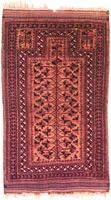
Baluchi rugs are mainly geometric. The Baluchi tree-of-life prayer rug is the most well known of all Baluchi designs. Even though Baluchi rugs are sometimes sold under the name of the specific tribe which has woven them such as the Mushwani, Nishapur, Dokhtar-e-Ghazi, Koudani and Haft Bolah and the village of Chichaksu, often times Baluchi rugs are marketed by the names of Mashad or Herat Baluchi. Herat Baluchi rugs are made in Afghanistan and are mainly prayer rugs. The Mashad Baluchi rugs are made in Iran and are generally all-over repeats.
This guide is the text of our earlier site’s Learn About Rugs section, written between 2011 and 2013; figures such as populations and export shares date from then.