On this page
In the Attributes section, we have been able to create a very unique and simple way of learning about rugs and distinguishing one from another. We have created 13 attributes by which we can classify all the rugs in the world. These attributes include size, color, layout, pattern, style, make, pile, weave, foundation, knot, category, age, and condition. By creating this unique method of classification, we are able to communicate with our visitors by increasing their knowledge of handmade rugs in an easy and fun way. As a result, we can help them make well-informed choices.
Size
When talking about sizes of handmade rugs, we also need to discuss their shape. Handmade rugs are made in different sizes and shapes. Since most handmade area rugs are rectangular, only this shape rug has been assigned standard sizes. Other shapes include runner, round, oval, square, and some odd shapes. We will discuss each shape and their dimensions in detail; however, as a general rule choosing the correct size rug depends on the dimensions of the room or space you are trying to cover. Handmade rugs are not intended to cover the entire floor. Because handmade rugs are a work of art, similar to paintings, they need a frame to enhance their beauty. This frame is created by allowing at least one to two feet (30 to 60 centimeters) of open space between the rug and the surrounding walls.
Size is a very important factor in pricing a handmade rug. Therefore, understanding the units of measurement used in determining the dimensions of a rug are also important. The length and width of rugs can be expressed in both the British Imperial System (feet and inches) and the Metric System (meters and centimeters). Likewise, the area of the rug is calculated in square feet in the British Imperial System and in square meters in the Metric System. Every foot is equal to 12 inches, and every meter is equal to 100 centimeters. Also, every foot is equal to approximately 30 centimeters. Therefore, every meter is equal to 3.28 feet.
Shapes
The following is a list of different rug shapes and methods of measurement used for each one.
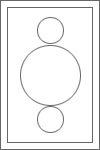

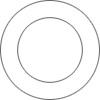
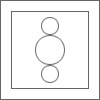
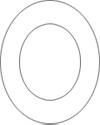

Rectangular
Rectangular rugs, also called regular rugs, are the most common rugs in the world and come in a variety of sizes. Therefore, standard sizes have been assigned to rectangular rugs in order to make rug selection an easier process. However, standard sizes are not exact sizes.
In the rug industry, a rug with measurements of 8 feet and 4 inches wide and 10 feet and 4 inches long is still called an 8 by 10 (8x10). Two sets of standard sizes exist, the Imperial British standard and the Metric standard. Below, we have a list of standard sizes in the Imperial system, and then a list of the Metric standard sizes below.
Standard rug sizes
British imperial system (width x length)
- 2' x 3'
- 2' x 4'
- 3' x 5'
- 4' x 6'
- 5' x 8'
- 6' x 9'
- 7' x 10'
- 8' x 10'
- 9' x 12'
- 10' x 13'
- 10' x 14'
- 12' x 15'
- 12' x 18'
- 13' x 20'
- 14' x 21'
Metric system (width x length in meters)
- 0.50 x 1.00
- 1.00 x 1.50
- 1.50 x 2.00
- 1.50 x 2.50
- 2.00 x 2.50
- 2.00 x 3.00
- 2.25 x 3.25
- 2.50 x 3.50
- 2.75 x 3.75
- 3.00 x 4.00
- 3.50 x 4.50
- 3.00 x 5.00
- 3.50 x 5.50
- 4.00 x 6.00
- 4.00 x 7.00
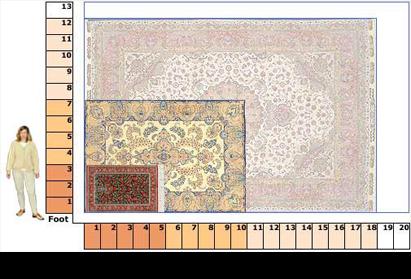
Oversize: Any size approximately larger than 14 x 24 ft or 4.00 x 7.00 m
Runner
Runners are the second most common shape of rug. They are very long and narrow rectangular rugs. Most runners in today's market are between 2.5 to 3 feet wide and 6 to 20 feet long, and in some cases even longer. They are used as coverings for hallways, stairways, and entrances. For this reason, they are also called Corridor rugs. The use of runners on stairs is a more common practice in the United States than in Europe. Until about 60 years ago, runners were also used in traditional Persian room arrangements. Many Persian living rooms were covered with a traditional set of rugs including one main piece, Mianfarsh or middle carpet, of approximately 6 to 8 feet wide by 16 to 20 feet long. At the head of the room, a runner called Kellegi was placed. Kellegi measured between 4 to 6 feet wide with a length of about two to three times its width. On each side of the middle carpet, two very narrow and long runners called Kenareh were placed. Kenareh measured between 2.5 to 5 feet wide and anywhere between 5 to 40 feet long. Food was placed on a cloth on the middle rug. The elderly and the host would sit on the headpiece, and everyone else would sit on the two side rugs. All four pieces were sold as a set. A complete set can rarely be found now. Today, as mentioned above, runners are mainly used to cover hallways and stairways, and the wider ones tend to be used for entrances.
Round
The length and width are equal in a round rug, and they are the same as the diameter of the rug, so when looking for a round rug, look for sizes such as 4x4, 8x8, etc. Round rugs are unique and rare. The oldest round rug is a sixteenth-century Mamluk. Mamluk rugs were woven in Egypt and had complex geometric designs with large medallions. Round rugs were also woven in French Aubusson and Savonnerie styles in the seventeenth and eighteenth centuries. Round Chinese rugs were woven for the first time in Tientsin and Beijing in the early nineteenth century. Both new and old Chinese round rugs are still available in the market. In the past 40 years, round rugs have become more popular in Iran, and are mainly woven in the cities of Tabriz, Esfahan, and Nain. The layout of most round rugs tends to be medallion.
Oval
Oval rugs are unique and rare in shape. Therefore, no standard sizes have been established for them. However, oval rugs are measured in the same fashion as rectangular rugs. The larger diameter is considered the length, and the smaller diameter is considered the width.
Oval rugs are similar to round rugs in their history and design. They have originated from Chinese and French Aubusson and Savonnerie styles. In the last 40 years, they have become popular in Iran. They are mainly woven in the cities of Tabriz, Esfahan, and Nain. Regardless of their origin, their layout is usually medallion.
Square
Square rugs are very unique and rare. As their name implies, they have equal width and length. Therefore, when looking for a square rug, look for sizes such as 4x4, 8x8, etc. Square rugs are an ideal fit for square rooms.
Odd shapes
At times, you will encounter hexagonal, octagonal or even triangular rugs. They are mostly rarities rather than the rule.
Industry rug names
It is very common in the rug industry to name rugs according to their sizes.
Below you will see a list of common rug names in Persian, Turkoman, Turkish, and some in English with their measurements next to them.
- Area rugs
Any rug that does not cover the floor wall to wall.
- Zar
An outdated Persian linear measurement of about 1.04 to 1.12 meters or 41 to 44 inches. This term is important in understanding the following terms.
- Zar-charak (Persian)
Very small qaliche, a rug size about 2.5x4.5 ft (one and one quarter zar in length).
- Zar-o-nim (Persian)
Small qaliche, a rug size about 3x5 ft (one and a half zar in length).
- Do-zar (Persian)
Medium qaliche, rugs of about 7 feet (two zars) in length and about 4.5 feet in width.
- Pardeh (Persian)
Large qaliche, a rug size of approximately 5x8 ft or 5.5x9 ft. The Turkoman name for Pardeh is Enssi. Enssi is a rug used in place of a door or curtain in a Turkoman tent. Pardeh also means curtain in Persian.
- Qali, Ghali (Persian)
Any large rug measuring over 6x10 ft.
- Qalin (Turkoman)
A rug larger than 6x9 ft.
- Qaliche, Ghaliche (Persian)
Any small rug measuring under 6x6.5 ft. "-che" in Persian is a suffix which means small, so qaliche literally means small qali.
- Qalincha (Turkoman)
A rug smaller than 9x6.
- Pa-dari (Persian)
A mat of approximately 2x2.6 ft. "Pa-" is used as a prefix here meaning foot (extension of a leg). "Dar" means door in Persian. Therefore, Pa-dari is a rug placed at the door where people step on.
- Pa-takhti (Persian)
A bedside rug of approximately 2x2.6 ft. "Takht" means bed in Persian.
- Pushti (Persian), Yastik (Turkish)
Pushti is a formal cushion covered with a rug of approximately 3x2 ft. These cushions are placed against the wall in living rooms. In such rooms where people sit on the floor, the main pieces of furniture are the rugs on the floor and the Pushti.
- Room-size rugs
All small to very large qalis can be called room-size rugs. This is a western term used for rugs which cover most of the floor. Typical sizes are 8x10, 9x12, 10x14, and 12x18 up to 14x24 feet.
- Small qali
Rugs of approximately 6.5x10 ft or 8x12 ft.
- Medium qali
Rugs of approximately 9x12 ft or 10x13 ft.
- Large qali
Rugs of approximately 12x14 ft or 11.5x15 ft.
- Very large ghali
Rugs of approximately 13x16.4 ft or 15x20 ft.
- Palace-size rugs, Oversize rugs
Rugs larger than 14x24 ft, which are usually custom-made.
Special-purpose rugs
The following rugs, which come in special sizes, have or at some point had specific purposes.
- PRAYER RUGS, SECCADE (TURKISH), SEJJADEH (ARABIC), JA-NAMAZ (PERSIAN)
These are one directional rectangular rugs of approximately 3.5 x 5.5 ft. Prayer rugs historically have been woven for Muslims to pray on. They still serve this purpose, and are also used as regular rugs. The usual design of a prayer rug is a mihrab (the prayer niche constructed in a mosque wall that indicates the direction of Mecca). Prayer rugs consist of symbolic objects such as columns, vases, lamps, combs, rosewater jugs, and the Hand of Fatima where the devotees place their hands when kneeling on the rug. Sometimes one, few or all of these objects are present in the rug. Prayer rugs are further discussed under Anatolian style.
- MIANFARSH-KELLEGI-KENAREH
A special category of rugs is a four-piece set, which their production came to an end about 60 years ago. These rugs were only made in Iran and were sold as sets. A complete set can rarely be found now. Many Persian living rooms were covered with these traditional sets, which included one main piece, Mianfarsh or middle carpet, of approximately 6 to 8 feet wide and 16 to 20 feet long. At the head of the room, a runner called Kellegi was placed. Kellegi measured between 4 to 6 feet wide with a length of about two to three times its width. On each side of the middle rug, two very narrow and long runners called Kenareh were placed. Kenareh measured between 2.5 to 5 feet wide and anywhere between 5 to 40 feet long. Food was placed on a cloth on the middle rug. The elderly and the host would sit on the headpiece, and everyone else would sit on the two side rugs.
Color
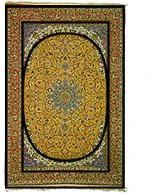
In creating a work of art, the two most important elements are design and color. We could even say that color is more important than design because it is by color contrast that design is created, whether that work of art is a black-and-white portrait or a colorful handmade rug.
In handmade rugs, colorful motifs are woven into the rug against the solid color in the background and the border, creating even more incredible color contrast. All handmade rugs are identified by their background color and border color.
Colors are also an important factor in determining the origin of handmade rugs. Different rug producing areas use different combinations of colors and different types of dyes. Colors are chosen according to the best dyes available in the environment whether natural or synthetic, and even sometimes according to their symbolic values (traditional and religious meanings).
Background color
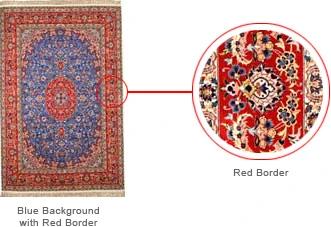
This is the dominant color in the background of the area rug. Background color is the underlying color of the entire rug with the exception of the border. In some cases, however, the background and the border color are the same.
Handmade rugs contain many different motifs woven with exquisite colors. The motifs rest on a background woven in a solid color. The most widely used background colors are red, blue, beige, and yellow. These colors come in various shades and hues.
Border color
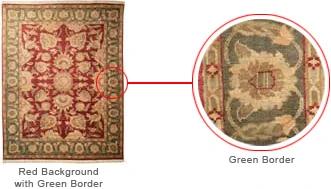
In many area rugs, the border color is not as readily distinguished as the background color. One reason is that there are always colorful designs and patterns in the border of the rug, and hence they overshadow the actual border color. But if you examine the border carefully, you will be able to discern the dominant color in the border. Major border colors are red, blue, beige, yellow, and green. These colors come in various shades and hues.
Layout
Layout is the overall arrangement of motifs or objects woven into a rug. Motif is any single form or interrelated group of forms which make up part of the overall design. All rugs can be divided into three major layouts of all-over, medallion, or one-sided.
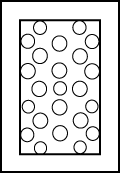
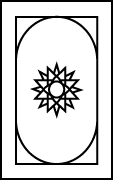
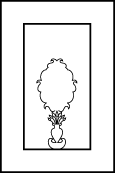
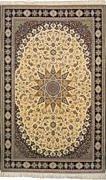
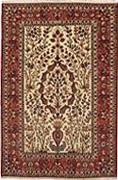
All-over, medallion and one-sided
All-over
In this layout, there are no dominant or central designs. The motifs on the rug are spread throughout the area rug. Sometimes they are connected and sometimes they are separate. Usually a single motif or a group of motifs is repeated throughout the rug. The motifs could be small and repeated many times, or large and repeated only a few times. The Persian name afshan, which means scattered, has been given to the all-over layout. Some common designs that fall under this layout are repeating, endless repeat, and panelled.
In a repeating design, which is a very common example of the all-over layout, a single motif or group of motifs is repeated throughout the rug as mentioned above. In an endless repeat, the motifs do not end and are interrupted by the borders. Some say this design is symbolic of eternity. In a panelled design, the background is divided into compartments. The same motif could be repeated in all the compartments, or different motifs could be repeated in different compartments.
Some common motifs used in the all-over layout are boteh, gul, herati, lattice, mina-khani, mir-i-boteh, and lotto (see Common motifs in all-over layouts, below, and the glossary).
Medallion
In this layout, a large centerpiece called medallion is the focal point of the design. In Persian, this centerpiece is called toranj. The medallion layout is by far the most frequently encountered layout in every handmade rug producing country.
Common shapes of the centerpiece are oval, circular, diamond, octagonal, hexagonal, and stars. One special case of a medallion layout is called medallion-and-corner, which was originally inspired by bookbindings, especially those of the holy book of Islam, Quran. This special medallion is distinguished by its quartered medallions in four corners of the rug in addition to the full medallion in the center. The corner elements are called spandrels or lachak in Turkish. Medallion-and-corner is also known as lachak-o-toranj (a Turko-Persian word).
Sometimes there are small floral extensions at the top and bottom of the medallion called pendants. The pendants usually consist of two parts. The part closer to the medallion is called katibeh and the part further away from the medallion is called kalaleh in Persian.
One-sided
In this layout, the design is woven in one direction. Therefore, the rug can be properly viewed only from one side, similar to a photograph. For this reason, this layout is also known as one-directional. Prayer and pictorial rugs fall into this category.
The usual design of a prayer rug is a mihrab (the prayer niche constructed in a mosque wall that indicates the direction of Mecca); pictorial rugs portray people, animals, and places. It is essential that one-sided rugs be viewed from the right direction; otherwise, they lose much of their effect. Rugs of this layout should be placed where they cannot be seen upside-down. For example, the top side of the rug could lay against a wall, or the rug could be used as a wall-hanging.
Common motifs in all-over layouts
The following are some common motifs used in an all-over layout. Motif is any single form or interrelated group of forms which make up part of the overall design.
Boteh (Persian for "bush")
A pear-shaped figure usually used in the field of an all-over repeat layout. There are many versions of boteh, from geometric to curvilinear and simple to complex. Boteh has been thought to represent a leaf, a bush, a flame, or a pinecone.
Shah Abbasi
A group of palmettes that can be seen in all-over and medallion layouts as well as in borders. This motif is frequently seen in rugs of Kashan, Esfahan, Mashad, Nain, and in rugs of countries which copy Persian styles such as India, China and Pakistan.
Gul, Gol
A motif in the shape of an octagon used in Turkoman designs. Usually, one gul is repeated in an all-over layout. Gul is the Persian name for flower. However, some rug scholars argue that the Turkoman gul has originated from an ancient Turkish word meaning family or tribe, and historically each tribe had its own symbolic version of gul.
Herati (fish)
A motif consisting of a flower inside a diamond and curving leaves outside the diamond which are parallel to each side. This motif is commonly used in the field of an all-over layout. The leaves sometimes look similar to fish. There are many versions of the herati motif, from geometric to curvilinear and simple to complex.
Pattern
Pattern is one of the most helpful elements in narrowing down rug selection, especially after size and color. It is also a helpful element in finding the style and make of a rug. We could define pattern as the way lines are used to form shapes on a rug.
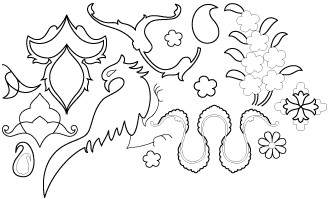
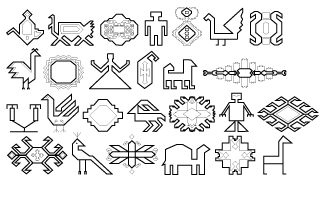
Curvilinear, geometric and pictorial
In the rug industry, pattern is divided into the three categories of curvilinear, geometric, and pictorial. The following is a description of curvilinear pattern.
Curvilinear
Patterns created with smooth curving lines are called curvilinear. Curvilinear patterns can be seen in all three layouts of all-over, medallion, and one-sided. Creation of curves generally requires a higher knot density. However, a high knot density does not automatically result in a curvilinear pattern. In curvilinear rugs, the pattern is usually drawn on a squared paper knot by knot. This extremely detailed drawing is called cartoon. Then the pattern is carefully copied from the cartoon onto the rug. This technique is more commonly used in workshops. Kerman, Kashan, Esfahan, Nain and Qum styles are good representations of the curvilinear pattern.
Geometric
Patterns created with straight lines are called geometric. Their designs are created mostly with right angles, diagonals, triangles, and other geometric shapes. Geometric patterns can be seen in all three layouts of all-over, medallion, and one-sided. With some exceptions, geometric rugs are predominantly woven by nomadic tribes and village groups. The ones woven by nomads tend to be simple and the ones woven by villagers or workshops can have either simple or very complex motifs such as geometric rugs of Heriz (Persian) style, which are very intricate. Baluchi, Turkoman, Turkish and Caucasian styles are good representations of the geometric pattern.
Pictorial
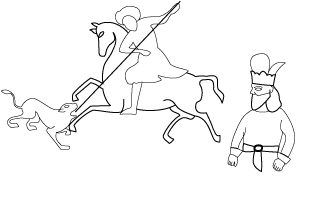
Pictorial rugs portray people and/or animals and are usually based on history and mythology. The naturalistic and realistic depiction of people and animals is not very common in the East; therefore, pictorial rugs are a special and less common pattern. Sometimes they consist of one or more figures (usually famous), and sometimes they depict a famous historical event.
Even though a few nomadic groups such as the Baluchi occasionally produce items with pictorial pattern, pictorial rugs are mainly produced in workshops and woven from fine cartoons. Workshops of Iran (particularly Kerman, Tabriz, and Kashan), India, and Pakistan to some extent, are the major producers of pictorial rugs. Since the beginning of the 19th century many pictorial rugs have also been woven in China. Turkey, Afghanistan, and the Caucasus are not in the tradition of making pictorial rugs.
Style
Style could be defined as the way different motifs, colors and patterns give character to a rug. The styles page discusses the most important styles of rugs that have existed or still do exist in various parts of the world. Rug styles of the world include Persian, Chinese, Turkoman, Caucasian, European, Anatolian, Tibetan, Indian, Baluchi, North African, Native American, and East Turkestan. In addition, many of these styles have sub-styles; for example, Tabriz is a sub-style of Persian style.
Many styles or sub-styles are made in their place of origin as well as in other countries or areas. For example, a Tabriz style rug may be made in Tabriz; it could also be made in India.
Make
Make is the actual location where a rug is produced. A rug produced in India may be Persian style and could be sold under the name of its style. At the same time, an area rug could be produced in the same exact place where its style first originated. Therefore, sometimes the style and the make have the same name, and sometimes they have different names.
When buying a handmade rug, one needs to know not only the name of its style, but also its make because make could be a factor in the value of the area rug.
Rugs are currently produced, or have been produced in the past, in many countries and areas. These places include Iran, India, China, Pakistan, Turkey, Afghanistan, Armenia/Azerbaijan/Georgia, Morocco/Algeria/Tunisia, Turkmenistan/Uzbekistan, Tibet/Nepal, Romania/Bulgaria/Albania, Egypt, France, North America, Ireland, and Spain. The glossary describes each; of the old pages on them, only Tibet and Nepal’s survives, below.
Tibet and Nepal
Tibet is considered an administrative region of China; its official name is the Tibet Autonomous Region (TAR), and it is located in the southwestern part of China. It is bordered by Nepal, Bhutan and Myanmar (Burma) on the south, and India on the south and west. The TAR occupies an area of about 472,000 sq miles (1,222,000 sq km). The TAR's capital city is Lhasa. According to the 1990 census, the population of the TAR was 2.2 million, the least populated part of China.
Nepal is a country located in South Asia. It is bordered by China to the north and India to the east, south, and west. It covers an area of 56,827 sq mi (147,181 sq km) with a population of approximately 23.6 million. The capital of Nepal is Kathmandu.
Tibetan rugs seem to have been influenced by Chinese and to lesser degree East Turkestan rugs. Tibetan rugs were mainly produced in Tibet for local use. However, after the Tibetan uprising of 1959, many Tibetans escaped to Nepal, Bhutan and India. In refugee camps, they began considerable commercial rug production. A rug industry did not exist in Nepal before the migration of Tibetan refugees.
The important weaving centers of Nepal include Kathmandu, Pokhara, and Patan. Today, Tibetan style rugs made in Nepal are known as Tibetan rugs. Even though Tibet itself is not a major rug exporter, Nepal today is among the major rug exporters of Tibetan rugs to Europe. In addition, many Tibetan rugs made in Tibet and India are exported from China and India to Europe and the US.
Pile
Pile refers to the material (fiber) used for weaving rugs. Only natural fibers are used in handmade rugs. The main pile materials are wool, silk and cotton. Sometimes, goat and camel hair are also used by nomadic and village weavers.
Wool
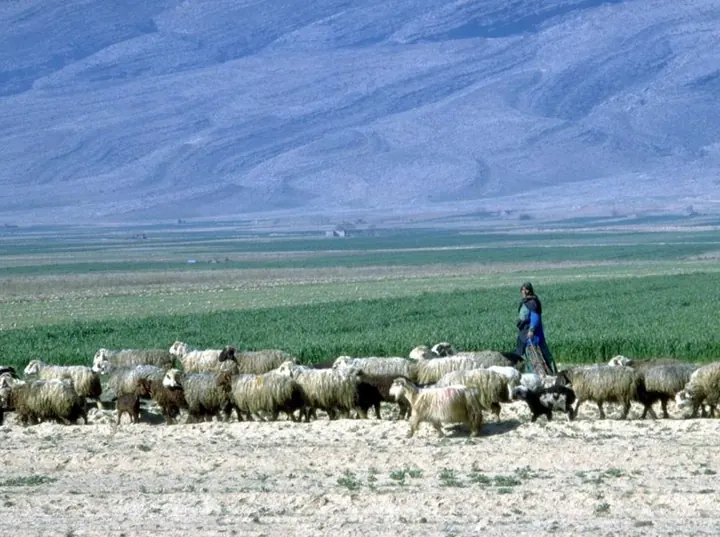
Wool is the most frequently used pile material in handmade rugs because it is soft, durable, easy to work with and not too expensive. This combination of characteristics is not found in other natural fibers. Wool comes from the coat of sheep.
Fibers from animals such as goat or camel are considered hair, and even though the use of some hair in rugs adds shine, their extensive use is undesirable because they do not dye well. Moderately coarse wool is more durable than fine wool, and the sheep producing this kind of wool can usually be found in the Middle East. In general, wool from sheep grazing at high altitudes is superior, and very high quality wool can be found at high altitudes of the Caucasian mountains and mountainous areas of Iran. Wool from China, Australia and New Zealand is also very good. Natural wool comes in colors of white, brown, fawn, yellow and gray, which are sometimes used directly without going through a dyeing process.
Silk
Silk is an expensive fiber, and therefore, it is less frequently used in handmade rugs. Silk comes from the cocoon of silkworms, which thrive on mulberry leaves. Silk originally came from China and it was then cultivated in countries such as Iran, Turkey, India and some countries of the ex-Soviet Union.
The best quality silk still comes from China and an area of Iran in the south shores of the Caspian Sea. Silk has the two qualities of fineness and strength, hardly found in other natural fibers. Silk can be used alone or in combination with wool. Because of their fineness, pure silk rugs require more care. Therefore, they are generally used as decorative items and hung on walls, or if used as floor coverings, they are placed in rooms with less traffic.
Cotton
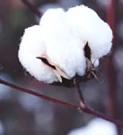
Cotton is used primarily in the foundation of rugs. However, some weaving groups such as Turkomans also use cotton for weaving small white details into the rug in order to create contrast.
Weave
Weave refers to the technique used in making handmade rugs. There are three major techniques: pile weave, flat weave and hand-tufted.
Pile weave
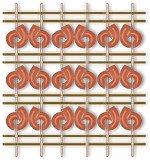
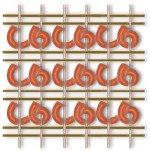
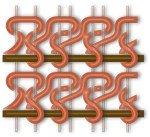
Pile weave or knotted weave refers to the method of weaving used in most rugs. In this technique the rug is woven by creation of knots. A short piece of yarn is tied around two neighboring warp strands creating a knot on the surface of the rug. After each row of knots is created, one or more strands of weft are passed through a complete set of warp strands. Then the knots and the weft strands are beaten with a comb securing the knots in place. Even though all pile rugs are woven with knots, different weaving groups use different types of knots. The weaving process begins at the bottom of the loom and moves upward as the horizontal rows of knots and wefts are added.
Every single knot is tied by hand. A rug can consist of 25 to over 1000 knots per square inch. A skillful weaver is able to tie a knot in about ten seconds, meaning 6 knots per minute or 360 knots per hour. That means it would take a skillful weaver 6480 hours to weave a 9x12-foot rug with a density of 150 knots per square inch. If we divide this number by 8-hour working days, that means it would take one weaver 810 days (approximately two and a half years) to weave such a rug. A rug as large as a 9x12 is usually woven in a workshop or master workshop setting by two or three weavers, so the above time can be reduced by half or third. Imagine if the knot density is even higher! Handmade rugs are functional and exceptional works of art created with great patience.
The old site’s pages on flat-woven and hand-tufted rugs were not preserved; the glossary describes flat weave, kelim and soumak.
Foundation
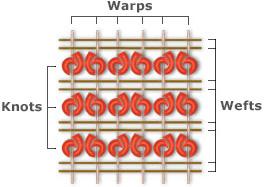
Foundation refers to the basic structural components of handmade rugs. These components consist of warps and wefts.
Warp
Warps are vertical strands of fiber which stretch from the top to the bottom of the rug. Warps are an extremely important component because the knots are tied to them and the weft strands are passed (woven) through them. Even tension of all warp strands is essential in producing a rug without wrinkles. The extensions of warp strands are rug fringes. Fringes are knotted at the ends to ensure that the wefts and the knots do not unravel.
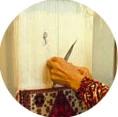
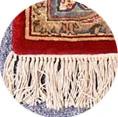
Weft
Wefts are horizontal strands of fiber that are passed (woven) through the warp strands. Unlike the warps, wefts are not structured prior to weaving. They are added before and in between the rows of knots to secure the knots in place. Each side of the area rug, where the wefts begin and end, is called selvedge.
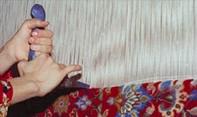
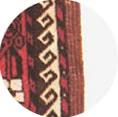
Foundation material
In general, the same material is used for both warp and weft, and it is often cotton. Wool is used as a foundation material in some nomadic and village rugs because wool is readily available to these weaving groups. Silk is generally used in foundation of rugs with silk piles. Rugs with silk foundation and pile are very exceptional and expensive. These rugs are light in weight and are very finely knotted. Silk is a very good foundation material for area rugs because it is very strong and keeps its shape.
Knot
Pile-woven or knotted rugs are created by knots. Most handmade rugs with the exception of kelims are woven by tying knots on the warp strands. The type of knot used in weaving and knot density are discussed below.
There are different methods by which knots are created. The two predominant types of knots are asymmetrical and symmetrical. There are other kinds of knots as well such as jufti and Tibetan. However, they are not as frequently used.
Knot density
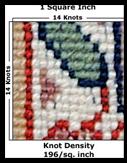
Knot density refers to the number of knots per square inch or square decimeter in a handmade rug. Knot density is measured in the imperial system in square inch and in the metric system in square decimeter. Every decimeter is equal to 10 centimeters and approximately 4 inches. Knot density is measured by counting the number of knots per linear inch or decimeter along the warp and weft (visible on the backside of the rug) and multiplying the two numbers. Since usually the two numbers are the same, one number can simply be squared.
Knot density could be a factor in the value of a rug, but this is not always true. In nomadic and some village items, knot density is usually not a factor. It is not a factor for collectors of these rugs either because nomadic and village rugs are judged by different standards than workshop rugs. Nomads and village groups do not have the same sophisticated tools as other city weaving groups. Their items are valued by the fact that their designs are created from memory, their dyes and materials are provided from the nature around them, and most importantly the weavers' way of life is expressed in them. These rugs generally have a knot density of between 25 to 100 knots per square inch. Rugs with higher knot density take a longer time to make, and since nomads migrate as the seasons change, if their rugs are not finished in time for migration, they will have to carry the looms with them. Therefore, their rugs tend to have a lower knot density than workshop area rugs. The value of these rugs lies in their heritage and simplicity. They have artistic value.
Knot density is a factor, among many other factors, in the value of workshop rugs or in other words city rugs. Since workshops have more sophisticated tools (though of varying degrees of sophistication) and follow cartoons (drawings on squared paper) for their designs, precision becomes important. Knot density, although irrelevant in durability of the rug, becomes important for creating intricate curvilinear designs because the higher the knot density, the more detailed the design can be. Workshop rugs can have a knot density of between 100 to over 1000 knots per square inch. Rugs of over 1000 knots per square inch are very rare and most likely very expensive. These rugs are generally pure silk with silk foundation because with silk foundation more knots can be tied. With cotton or wool because the strands are thicker, it would be difficult to tie this many knots in one square inch.
All handmade rugs are functional and exceptional works of art created with great patience. Every single knot is tied by hand. A rug can consist of 25 to over 1,000 knots per square inch. A skillful weaver is able to tie a knot in about ten seconds, meaning 6 knots per minute or 360 knots per hour. That means it would take a skillful weaver 6,480 hours to weave a 9x12-foot rug with a density of 150 knots per square inch. If we divide this number by 8-hour working days, that means it would take one weaver 810 days (approximately two and a half years) to weave such a rug. A rug as large as a 9x12 is usually woven by two or three weavers, so the above time can be reduced by half or third. Imagine if the knot density is even higher!
Asymmetrical (Persian or Senneh) knot
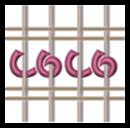
The asymmetrical knot is used in Iran, India, Turkey, Egypt and China. To form this knot, yarn is wrapped around one warp strand and then passed under the neighboring warp strand and brought back to the surface. With this type of knot a finer weave can be created.
Symmetrical (Turkish or Ghiorde) knot
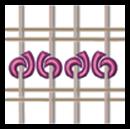
The symmetrical knot is used in Turkey, the Caucasus and Iran by Turkish and Kurdish tribes. It is also used in some European rugs. To form this knot, yarn is passed over two neighboring warp strands. Each end of the yarn is then wrapped behind one warp and brought back to the surface in the middle of the two warps.
Jufti knot
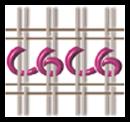
The jufti knot can be seen in rugs of Khorasan, Iran. This knot can be either symmetrical or asymmetrical. The knot is usually tied over four warps making the weaving process faster.
Tibetan knot
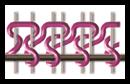
In Tibet, a distinctive rug-weaving technique is used. A temporary rod which establishes the length of pile is put in front of the warp. A continuous yarn is looped around two warps and then once around the rod. When a row of loops is finished, then the loops are cut to construct the knots.
Category
Handmade rugs are produced in different settings referred to as category. Handmade rugs are generally woven in the settings of nomadic, village, workshop and master workshop.
Nomadic
Nomadic rugs are woven by tribes who are mostly sheepherders, live in tents and migrate to the mountain pastures in the summer. They include the Lurs, Qashghais and Bakhtiaris of Iran, Turkomans of Afghanistan, Uzbekistan, Turkmenistan, and the area of northwestern China (known as Turkestan in ancient times), and other tribes of Turkey. Rug weaving is part of their culture and life rather than an occupation. They weave rugs for their everyday usage. Women are the sole rug weavers in nomadic tribes. Their expertise in rug weaving is an important factor in determining their social status. Girls learn this skill from an early age and in most tribes they show their first work as proof of their eligibility for marriage.
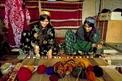
Nomadic tribes use small horizontal looms that can be dismantled rapidly at the time of migration. As a result, nomadic rugs are usually small. They are also limited in range of colors because nomads use natural colors that are few but available in their surroundings. Nomadic rugs usually have geometric patterns with bold and simple motifs. The nomadic rugs that reach the Western market are originally woven for personal use. The beauty of nomadic rugs lies within their heritage and simplicity.
Village
Village rugs are woven by villagers. In village settings, usually all family members or the women of the family are weavers and their home is their place of work.
More variety of styles are woven by villagers than by any other weaving category because village weaving has been influenced by both nomads and the nearby cities. The influence of nomads can be seen in the bold and simple motifs used by villagers. Many nomads have settled in villages and brought with them their traditional styles and techniques. At the same time, many village weavers accept orders from rug dealers or choose their patterns according to the demand of the market in nearby cities, and this influence can be seen in the elaborate and complex motifs used by villagers. Contemporary village rugs are mainly woven in Iran, Turkey and, to a lesser degree, Afghanistan.
Workshop
In a workshop setting, both men and women are employed, and very skillful weavers can eventually become master weavers and receive widespread recognition and financial rewards.
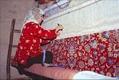
Workshops are far more sophisticated than nomadic tents or village settings. They have more sophisticated tools such as large permanent vertical looms, and use a large variety of dyes. Also, rug weavers usually work from a cartoon (a drawing laid out on squared paper) or work under the supervision of a master weaver who calls out both the weaving and the color of each knot. As a result of this sophistication, workshop items are technically very exact and can be produced in variety of sizes including very large sizes. In addition to the styles of their own area, many workshops weave rugs in other styles as well.
Master workshop
Master workshops are specialty workshops run by usually a well-known master designer/artist. The rug weavers are talented students who are directed by the master designer. In this setting very unique rugs are woven. Some are of traditional Persian schemes such as miniature paintings, some are of abstract schemes portraying contemporary life, and others are a combination. Many of these rugs look like paintings. Master workshop rugs are technically perfect with very fine knotting, exact patterns, uniform color tones, and the very best materials.
Master workshops pay attention to the artistic aspect of weaving rather than the market demand. These intricate rugs are woven for the purpose of creating art. Many master-workshop rugs are displayed in galleries and museums. Two of the well-known master designers of Iran are Seyrafian and Arabzadeh, and some well-known master workshops of Iran are located in the cities of Tehran, Esfahan and Tabriz.
Age
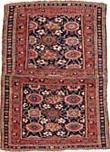
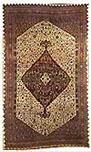
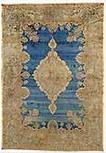
The age attribute specifies how old a rug is. There are three major timelines: antique, semi-antique and contemporary area rugs. Sometimes the date of creation is woven into the rug.
Antique
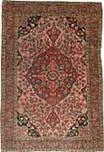
Rugs over 60 years old are considered antique.
Semi-antique
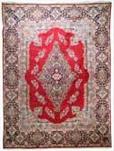
Rugs between 25 to 60 years old are considered semi-antique.
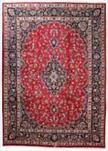
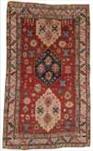
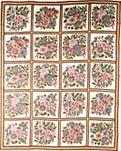
Contemporary
Rugs less than 25 years old are considered contemporary.
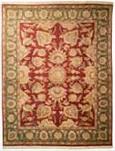
Condition
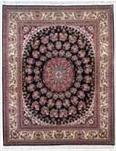
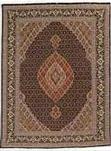
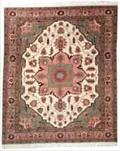
The condition of a rug is an important element because it affects the beauty and value of the rug. Handmade rugs are classified according to their overall condition. In the handmade rug industry these conditions are fine, average and worn.
Fine
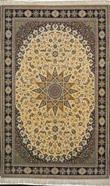
A fine rug is a rug in excellent shape with no stains, tears or holes, and no previous repair work. Since handmade rugs are very durable, most rugs are in fine condition. It is very easy to maintain a rug in its fine condition. For some maintenance suggestions, see our rug care guide.
Average
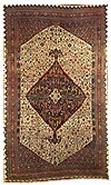
An average rug is a rug which may have undergone or may require some minor repair because of a few broken or torn warp strands, knots or fringes. If repair is needed, it could simply be done at a professional rug retailer.
Worn
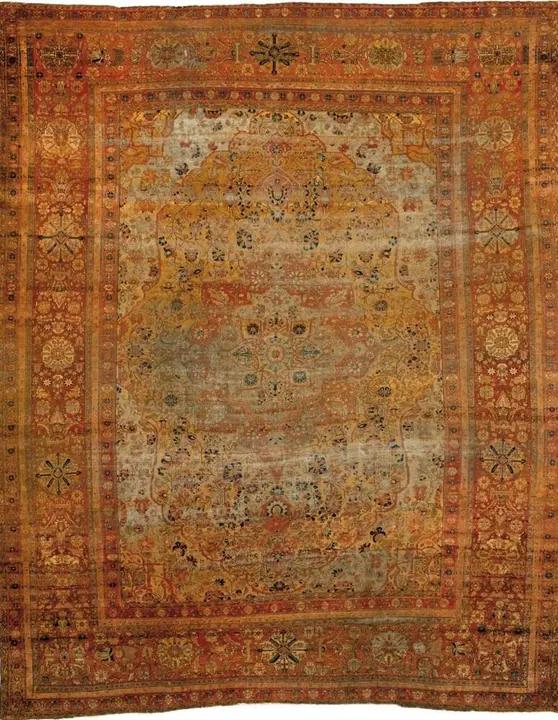
A worn rug is a rug which may have discoloration, fading, insect or foundation damage. However, rugs with no damage and only extensive pile wear are also considered worn. Worn rugs, even though worn, should not be dismissed because similar to fine and average rugs, they can still have a very good resale value. Some are even considered valuable antiques.
This guide is the text of our earlier site’s Learn About Rugs section, written between 2011 and 2013; figures such as populations and export shares date from then.